Ambivalence by Brain Dillon

Ambivalence by Brian Dillon

Irish Memoir

Source – Subscription book

I have had a Fitzcarraldo subscription for several years. I have always picked the mix of fiction and non-fiction because I see the white Fitzcarraldo as books that are culturally important and challenging, and also as books I would never normally buy, so they are there to remind me to be more daring as a reader and to read books in translation.  So I have a few other Brian Dillon books.  But the reason I picked this one up is that it follows Brian growing up in Dublin in the late eighties and early nineties, and since he is three years older than me, I knew the events in the book and the times I could relate to. Plus, I am a sucker for coming-of-age literature, whether fiction or non-fiction.

4 He is not always alone on his excursions into town.

For at least a year he has been in love with his best friend,

S: his blue eyes and his blue hair, an androgyny that was once flagrant and recently is becoming fixed into a mode of being that is more obviously gay (still secretly gay) and from which, once they have left school, he will feel himself slowly excluded. For now they keep to a near-nightly routine of long gossipy phone calls in which classmates and teachers are torn apart for their dullness, poor taste and pitiful efforts at wit. On evenings when S does not phone, or fails to return B’s calls: agonies of abandonment. Since their early teens they have shared an expanding star-chart of camp coordinates: girl groups of the 1960s; via Boy George (the singer who to their schoolfriends they insisted was not gay) the autobiography of the movie star Frances Farmer, incarcerated and abused at a psychiatric institution; the vicious-affectionate tone of TV comedians (Julian Clary, Victoria Wood) they imitate on their annual visits to the Ideal Homes Exhibition.

Boy George was a groundbreaking figure in many ways

I think I am maybe far below the likes of Dillon in my ability to talk about books and my life, but this book is about his growing up, and for me, it is hard not to compare this life to my own. I didn’t lose my parents at the age he did.  But I did have them split when I was young. I have two sides to my life: my mum and stepfather,  a man who, if still alive, would be a Reform Party voter, a vile man who, in many ways, ruined my teen years with the way he got in my head.  Then my dad and my stepmom.  My dad is a very clever man in his field, an expert. He has, ever since I can remember, had a book in his hand.  He is a leisure reader, a fan of thrillers and westerns, but between him and my grandmother, an English teacher like Brian, I grew up in a world of books.  But for me, I read the old white men of American Lit: Updike, Roth, Hemingway, Steinbeck, and Bellow, and, of course, I have always loved Graham Greene and Anthony Burgess.  But for me, I never was adventurous enough to read people like Brian Read as a young man: Barthes, Benjamin, et al  .  Seeing those years in his eyes, and his journey in books, reminds me of how much I need to read, but also of how life takes us on our own paths. I say this as whenever I mention things like this it sounds as though I am putting myself down; no life is life; you can’t turn back time.  Anyway, back to the book, I really have not even spoken about it yet.  Anyway, another parallel is when Brian, as a young man, connects with Bowie, hence the title of the book and how Bowie helped people with the ambiguous nature of their gender and sexual identities at a time this was rarely touched upon. Of course, being a few years older, my Bowie was, dare I speak his name, Morrissey, a man I defended for too long, thinking that the 80s persona was the real persona of this singer. Anyway, he talked about gender roles back then.

• An idea of androgyny is the guiding principle of his aesthetics-and politics. He has never been so certain of anything as he is of the necessity of this and all related terms-ambiguity, ambivalence, equivocation, paradox, etc.—which sound weak and boring compared to the god or goddess androgyny. He tries to imagine what it would mean to translate this way of being into prose, into the texture of response to the world, into a morality to replace the one he has been taught but not believed in since the age of twelve. He believes in a kind of abstract androgyny, which would render the world somehow more subtle, less sure of itself, but also irradiated with style, an affront to settled states of being.

I remember Morrissey saying something similar back in the 80s to this sad the change anyway

Anyway, I haven’t really said much about the book; it is a great personal Bildungsroman about a man I need to read more from, which makes me want to renew my Fitzcarraldo subscription to read his other books.  Another thing I may do is go back and draw a reading list of books mentioned by Brian in the book as a small project as all us readers know there is nothing better than making a list even if it ends with the list or even if I get the books for a future date it will make me remeber this book and how life is full of books books form so much of our lives alongside family and music. from a singer to a book from a family member it all inter.  connects and then connects with us as readers, thus forming a never-ending chain of connections.  Well, that is how it feels to me, as that is the sort of reader I am a reader of memoirs, of times of music, of connections we all make. I think this is a must-read for anyone like me in love with books and being a reader.

Two for the road by Roddy Doyle

Two for the road by Roddy Doyle

Irish literature

Source – library book

I am going to try to review it. Book a day in May, and I felt I needed a top-up from the library of short books to read. This was one of those books I remember people saying he had caught a type of guy that sits in a pub so well. I had read several Roddy Doyles books when he won the booker with Paddy Clarke ha ha. I read The Van and several others as well over the years and always loved the films made of his book. For me, he captures the funny side of Dublin life and the special characters that make that city rich, especially like this pair in a pub.
  • See Joe Cocker died.
  • What a fuckin’ voice.
  • Ah, man— But the best thing about him – he taught me tha’ Beatles were shite.
  • Hang on – wha’?
  • Me brother – he’s three years older than me – he brought home Sergeant Pepper’s. An’ everyone in the house loved it. Me ma sang ‘When I’m 64’ and she always cried at ‘She’s Leavin’ Home’, and me sister said, ‘Don’t worry, Ma, I’ll never run away like tha’? But she did – to fuckin’ London. She even met a cunt from the motor trade. But that’s a different story. Anyway—
  • What’s this got to with Joe Cocker?
  • I’m gettin’ there – calm down. They all loved ‘A Little Help from My Friends’ – in the house, like. Even me granny – an’ she hated fuckin’ everythin’. An’ I just thought somethin’ wasn’t right. But then he – me brother, like – he brings home Joe Cocker’s version. The single.
  • Brilliant.
  • No question. An’ me da shouts, five seconds in –

‘Turn tha’ shite down!’ An’ I knew it – in me heart. That’s the way it should be. If the oul’ lad reacts tha’ way, it’s good. If he hums along, it’s shite.

I pick this as I remember the cocker song being the theme to Wonder Years

Two for the Road captures those characters you find in a pub anywhere. Those people you meet for a brief moment or here every afternoon, this is a pair on the way home via the pub, a dying breed in the modern age, chatting about what has been in the news, the latest dead star, whether an actor or singer or a digression about a footballer I loved these as most of the players I knew or an event from the news. He really captured the voices. The use of language and words made these a pair of working-class guys. Some great insights into songs from the dead singers and the memories attached to them, like when Leonard Cohen died, they joked it was because he was a fan of women as a singer, and that had made Trump want him dead. Some classic football chats about great Irish players discussed which was the best. The last piece I laughed at was one of the books by Doyle that had been made into a film, The Snapper.
  • See Trump killed Leonard Cohen.
  • Saw tha’.
  • He doesn’t only hate women. He hates the men tha’ women love. ‘Specially older women.
  • Fuckin’ Clooney’s gone into hidin’.
  • Fuck him an’ his Nespresso.
  • And the Pope.
  • Fuck the Pope?
  • No. Women – they love him. Mine does, an’ anyway.
  • Poor oul’ Leonard. He was good, but. Wasn’t he?
  • Ah, he was. You should hear me grandkids singin’ Hallelujah’.
  • Good, yeah?
  • Fuckin’ hilarious.
  • The wife loved him.
  • Leonard?
  • She even became a Buddhist cos o’ Leonard.
  • Is tha’ righ’?
  • For a few weeks, just. Then she saw me eatin’ a quarter pounder an’ she said, ‘Fuck the Eightfold Path?

But she’s always on at me to wear a hat like Leonard Cohen’s.

Then I laughed at this about the passing of Leonard cohen

Doyle is the chronicler of Dublin’s working class and has a real ear for the way people of the city talk. He has an ear for his home town and how males, in particular, chat. When you speak this out loud, it seems perfect to me. He gives the two guys a true voice, and they seem real. There is a world-weariness in the way. They are speaking. I felt they are maybe in their 60s, with grown-up kids nearing the end of their working life. One imagines Doyle has chatted or observed pairs like this all his life. You have a sense he has an ear for a conversation overheard. These are like those. Each chapter is a day the two chaps meet over the course of five years. The book ends in 2019, a full year before COVID-19, and one wonders if these two would make it through the pandemic?  This book can be read over a beer or two easily. Have you read any books by Doyle? What is your favourite?
Winston Score – A a fun novella with a quirky pair chatting over their world

A Portrait of the Artist As a young man by James Joyce

A Portrait of the Artist As a young man by James Joyce

Irish fiction

source – personal copy

I haven’t done a post for St Patrick’s day for a number of years and the fact I was born in Northern Ireland I often feel I should do. A rereading of Ulysses last year which I had wanted to post a review of on Bloomsday but hadn’t finished it quite in time so I was left with a feeling I need to read another book by Joyce this year. But Finnegans wake is my next task but I settled for a reread of this which I hadn’t read since I brought the edition I read in Germany in the early nineties. This is work came out of a longer work Stephens Hero which Joyce had written 25 of what’re going to be 63 chapters. Of which Joyce was working on but abandon and reworked part of it into the novel. It is partly based on Joyce’s own life growing up in Ireland in the late 1890s.

Stephen’s heart jumped suddenly.

-Dedalus, sir,

-Why are you not writing like the other?

-I..my..

He could not speak with fright

-why is he not writing, Father Arnall?

_He broke his glasses, said Father rmall, and I exmepted him from work

-Broke? What is this I hear? WHat is your name is! and the prefect of studies.

-Dedalus, sir

-Out her, Dedalu. Lazy little schemer. I see schemer in you face. Where did you break your glasses

-The cinder path sir

-Hoho! The cinder path ! cried the prefect of studies. I know thatr trick

Dedalus gets caught by a sadistic schoolmaster just for looking like a schemer.

We meet the Dedalus Family early on in the book Stephen’s father is a man of leisure but as it turns out later in the book his business interests are failing in Cork. As he spends Christmas with the family as this is the first time he is viewed as an adult he is at the table as they talk about Parnall the Old Nanny Dante has a ribbon in her Hair for Parnell then we view Stephens school years as a young man described by his family as Sunny Stephen he falls foul of his fellow pupils at times like when he is asked does he kiss his mother at night innocently replies yes then get the mick taken out of him. Then we see him fall foul of one of the sadistic schoolmasters only because his glasses had broken he is called a lazy boy. There is a sense of the church in the background like when he here’s a sermon on the evils of the world that scare him. we follow him to he leaves school roughly the time through to the time of Ulysess which is 4th June 1904 the day he meets his wife Nora Barnacle. Ulysses like Joyce himself we see Stephen decided that the religious shackles of Ireland of the time weighed to heavy on his shoulder and like Joyce did he aims to move away from Ireland.

-How long is it since your last confession, my child?

-A long time father.

-A month, my child?

-longer, father.

-Six months ?

-eight months,father

He had begun. The priest asked

-And what do you remember since that times?

He began to confess his sins: masses missed, prayers not said, lies.

-Anyuthing else, my child?

Sins of anger, envy of others gluttony, vanity, disobedence.

-Anything else, my child?

There was no help. He murmured:

-I .. commited the sins of impurity, father.

He goes to conefession after a long time not going the power of the church runs through the book.


Joyce was called by his family Sunny Jim this echos in the book where he calls Stephen sunny Stephen. We also glimpse the sexual awakening of the young Joyce from a girl up the road and the echoes to Mercedes in the count of mount Cristo we see this sexual awaken further in Ulysess the book has echoes to the late work which reflects on the older Stephen and his friends. Here we see the child become a man his life of books his defense of Bryon at one point even when a fellow pupil calls him the poet for the simple and a heretic this is a look of growing up in the Ireland of the time where the catholic church is all-powerful. There is also the aftermath of the death of Parnell a man who was a heroin Ireland although in the church’s eyes flawed because of his affair. He was pushing for Home rule which he had laid the groundwork for Stephen rallies against those powers this is echoes in his name as well Stephen is both the first Christian Martyr and the major park in Dublin is also called after him. The Dedalus is from greek myth which has echoes to the story this is something that also happens in Ulysess. I love this book it is a classic bildungsroman a boy becoming a man and as we see him grow the language he uses moves on. I must now face the summit of The Wake!  this is essential for all readers of Joyce it is the link from Dubliner to Ulysess and the first time he used modernist style writing. Have you read this book?

Happy St Patricks day !!

Winstons score A+ one for my cannon!

Langrishe, Go down by Aidan Higgins

IMG_20160110_154231

I don’t read enough Irish lit over the years of this blog I have want to read a little as it is where I was born and my family have a history tied back to the 1600’s in Ireland. So when I saw the sad news of Aidan Higgins passing a few weeks ago, I decide it was time to read his debut novel which was considered his best book (I often feel this is a hard cross to carry as a writer when that first book is so praised and lauded it is always hard to hit a second home run. Higgins had written many books and after this I will be trying him again. Sorry it took his death for me to finally try him .

Cattle-Jobber; the man in the gap. A life given to bullocks ad heifers, stringers. Bone and gristle. Stewing fat, Helen Langrishe looked away. The heavy wheel ran on. She cleared the glass once more with the heel of her glove and stared out through the port-hole at the countryside now coming into sight on the left hand.

The conductor, worn leather satchel hanging down, was talking to another passenger, his hand outstretched for a fare. she regretted not answering him. The way it was at Springfield, they had got out of the way of exchanging common civilities.

Helen the sister on the bus back from Town at the start of the book with how bleak their lives are .

Langrische, Go down is the story that is very common in Irish history in the 20th century and that is the fall of a landed family. This is captured the family in what may be its last generation The three  langrische sister live in the decay ruin of the once proud home.We see after the opening chapter and the plight of the family when Helen returns and passes on the dire straits of the sisters lives. The main part of the story focus on the youngest sister Imogen and the one chance she gets to maybe carry on the family but also escape the world. This comes when the sister open their lives  to a German Student who is staying in one of the estates cottages.  The young sister falls for this Man with his views on the purity of Irish women. This is the story of two worlds meeting the dying British empire of old Anglo-Irish families like this one , the rise of Facism in Europe through Otto. Otto is a man who uses Imogen really for me I was reminded of some of Maugham’s characters in Otto the way he treated Imogen. He is a darker character than he first seems.

-Irishwomen, said Otto with fervour, they are so pure and clean.

-So cold?

-So pure, Otto said, and that’s not to be found any more in Germany– that great purity. But here you have it. And also that look in the face, the eyes, and one knows that such women are not corrupted. One knows it(thumping himself on the breast) Here

-Ireland is still rearing them still, Imogen said widening her eyes at him.

-A man might sometimes have filthy thoughts about girls. That’s natural enough. But when I meet Irish girls and can recognise at once their essential purity, then I am touched, incapable of a base thought.

Otto with Imogen she is still a virgin at 39 when she meets Otto is he the one?

This is one of those books where a lot doesn’t happen the beauty is in the way the prose draw you into the world of the sisters the decaying house what Higgins captures is the world that world of de Valera Ireland, which in some ways is the final nail in the sisters coffin so to speak the change of the world around them and them not able to catch up to the world. This isn’t a book for those who want a story. This is the story of broken grandeur the whole world of  Langrische sisters is dusty, ill or just about to fall apart. These are like characters in Paul Scott’s novel staying on or the spinster sisters in Agatha Christie’s  Nemesis The Bradbury-scott’s both of whom like the Langrishe have fallen out of step with the world around them.A richly written book by a writer that maybe should be better known. Have you read him ?

Irish Literature

Source – Library book

The history of the man in black by Oliver goldsmith

I going try to go through a few irish short stories for Mel of reading lives irish short story month .I was born in Ireland myself co down in the north and my family has a history on my father’s side going back over 300 years in Ireland ,so irish literature is something I read when young with frequent visits to family and friends meant I want to learn more about Ireland .But in the last ten years I ve read less and less so I chosen a few short stories and may try a few novels later this year after my IFFP reading .

so to the story it is told by a son his father was a poor member of a well to do family he had joined the church as a youngest son in Ireland at the time this was normal in middle class families the first son would inherit the second join the army and the third the clergy ,well his son wants some money as he dislikes his families poverty we see how he goes about it in this very short story of four pages ,it does capture a part of Ireland that was in existence for many years .All so shows how quick one could fall from well to do to poor in Ireland in the 1700’s

My father ,the younger son of a good family  was possessed a small living in the church .His education was above his fortune and his generosity greater than his education .

Opening of this short story .

Oliver Goldsmith was a Anglo irish writer alive from the 1720 to the 1770 .he grew up in Ireland went to trinity college in Dublin then went to london after college where he became a member of the club,the exclusive dining club run by Samuel Johnson and Joshua Reynolds ,they meet every two weeks and discussed art and writing .

This story is in my 10 volume collection the worlds thousand best short stories .

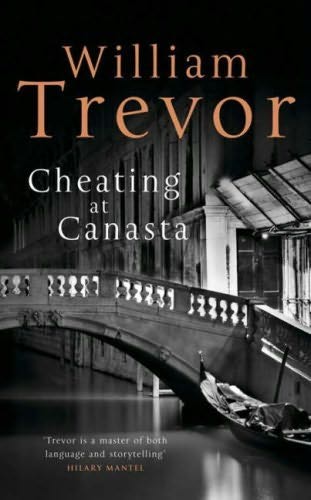
Cheating at canasta by William Trevor

Source – personnel copy

William Trevor without doubt in my humble opinion is the greatest living short story writer .he has won numerous awards and has been nominated for the booker prize on five occasions without winning a shocking oversight .He lives in Devon ,since the 60’s .His stories often touch on the outcasts and edges of society .

This collection of short stories was published in 2007 .if there is a theme to this book it is maybe loosely cheating ,a man in an italian cafe cheats at canasta ,a mechanic cheats some Spanish  tourists out of money for a repair  and in another a man returns to his home village from England as he felt cheat out of his inheritance ,but also a huge dark secret that he needs to see the priest about !Trevor wonderfully spins the human condition with all its foibles .We also touch on the very darkest people in society a paedophile on the lookout for a victim is a very harrowing story ,we also meet street gangs .These stories show that even thou he was nearly eighty when he wrote this collection ,he still has the finger on the pulse of  everyday life .

He was a shabbily dressed man ,almost everything he wore would having been abandoned by someone else .He had acquired the garments over a period ,knowing he intend to make this journey -the trousers of what had been a suit ,brown pin-striped ,worn shiny in the seat and at the knees ,a jacket that had been navy-blue and was nondescript now ,the khaki shirt he  wore an item once of military attire .

a bit from men of Ireland as Prunty returns to Ireland

As the quote shows Trevor has a great eye for detail .Like the other books by him I ve read I love his stories he always surprises me ,which is a real talent .all the stories in the collection are strong enough to stand alone which is good oft in collections by other writers there are a couple of what might be called in music terms filler tracks .this is like Bob  Dylan’s blood on tracks or Neil young harvest 100% wonderful from start to finish but also a collection that be great to visit again .I read this few weeks ago but held it for Mel of the reading life Irish short story week

Have you read Trevor ?

Who is your favourite short story writer ?