The Questionnaire by Jirí Gruša

The Questionnaire  by Jirí Gruša

Czech fiction

Original title – Dotazník

Translator – Peter Kussi

Source – Personal copy

I draw this first Czech lit month to an end with a classic one of the writers that stayed in Czechoslovakia and he had been working in the philosophy department in Prague and writing for a number of periodicals in Czech. But his writing came to the attention of the authorities. He wrote this book in 1974 and it was one of those book =s that in the day was handtyped and passed around an underground book there was 19 copies circulated. He was arrested and sent to jail for two months after worldwide protests at his arrest he then lived in Germany. After the fall of communism he worked for the government in foreign affairs as the ambassador to Germany for Havel’s government when died  Havel called him one of the few be close to I’m he deeply respected him. This is his best-known book as one man fills in an employee questionnaire and has the words on the top of the form DO NOT CROSS OUT.

1. GRANIT 01
On September 19, 197—, in the city of Prague (i.e., right here, not in the town of Chlumec), I visited the enterprise GRANIT, the sixteenth organization I had contacted over the past two years, and I received my sixteenth Questionnaire (in room 102, second floor), from
the hand of Comr. Pavlenda (Comr. = Comrade; i.e.,
friend, mate, companion, fellow member of a Communist society ).
In contrast to those previous questionnaires, this one was marked in the upper-right-hand corner, in blue pencil, most probably by Comr. Pavlenda himself: DO NOT CROSS OUT!—an exhortation

The opening and that command not to cross out thee questionnaire.

Jan Kepka is the man filling in the questionnaire. What follows is one of the most surreal works Kepka talks about around his family history is mother events during the war when a former Raf pilot during the war is a prisoner in the fifties. we see his family in the Czech countryside as he uses nature at times to explain the world around him. Our narrator Jan he is a garden designer and is applying for this job at Grant a low-level job as an Ensign this form he is given by the official Pavlenda. but the form is a stream-of-consciousness piece that drifts around events that happened like the 1968 uprising he uses his family history and past events to point out what is happening now from Nazis to communists it is kicking off regimes of how people are dehumanised. Jan tries to point out the pointlessness of the world. Surreal Twisting is a book that maybe needs a closer reading than I am as a reader. There are a lot of things like animals and insects recurring motifs that have a deeper meaning and maybe more of a meaning if you were sat in the dark in Prague reading the samizdat type copy of this book means more then. As we enter a series of questions answers twist and turn as our narrator digressions on the answers.

But the simple act of sliding the shoe-polish box to the window provided a definite basis for calculating the degree of Aryanism, according to Section A, para. 1, of government directive 156/40 (Regierungsverordnung).
The situation at the time was thus as follows:
a) Pater Stach was changing his cassock.
b) Jan Baptist Vachal, lodged in a small room in the chancery, was feeling much better in spite of having been told that he had lost a great deal of blood.
c) Prince Friedrich had passed the Anchor Inn on Jost Square, and was approaching St. Mary’s statue.
d) Kaspar Trubac was standing in front of his boarded-up store, trying to look as if the store was someone else’s property.
e) Alzbeta was peering through many human, and soon also equine, legs.

One of the many list and here in the war years

This is a clever book that points out the faults in the regime he was living under at the time but in that clever way that it isn’t direct but twisted and turns around to the point it is a surreal work and mixes history and the present the complex history of the Czech Republic during and after the war. This like the earlier book Golden Age I reviewed showcases the surreal nature of Czech writing during the 20th century. Thus this book has little plot and is sometimes more like a straight family history but is it. As I said it is maybe a book that needs a real close reading to dig deeper into it in fact it would have made a great group read for this month as it is a complex book about family, loss, Czech life and well not crossing out on the form !!. Have you read this book?

Winston’s score – B I felt I maybe needed to read this a few times to fully get the book it has so many twists and turns in it rich wordplay.

The Golden Age by Michal Ajvaz

The Golden Age by Michal Ajvaz

Czech Literature

Original title –Zlatý věk

Translator – Andrew Oakland

Source – Personal copy

Well, I’m back after my holiday refreshed and on to the second book for Czech Lit month and it is another from the Dalkey Archive Czech lit series. This is from the Czech Magic realist writer Michal Ajvaz, who is from a family of Russian exiles he has won a number of major prizes in his homeland. He has written essays on Derrida a book-length meditation on Borges and a study on the art of seeing these in ways that can all be seen in this novel of a mystical island a travelogue from a man who ended up on the island and came back.

There is no money on the island, a fact which in the 1960s provoked a French writer of the Left to produce an article which makes a point of describing the island’s society as a prototype for selfless brotherhoods of the future. The fallacy at the centre of his thesis is quite laughable: the islanders had not the remotest interest in philanthropy and humanism; indeed, their language possessed no words to give expression to these concepts. While the islanders absolute lack of appreciation for the accumulation of money was estimable and did much to clarify their behaviour, it was also connected with features of their character which were more difficult to take and by which I was often exasperated. Money is nothing but a pile of memory and anticipation by which we unchain ourselves from our given circumstances; the accumulation of money is a form of asceticism which holds back forces so that these may later form new shapes and deeds.

The ideal of the island had gripped others over time.

Our narrator tells of this unnamed island in the middle of the Atlantic. The city Built on the island has a European feel but the island is a community that has grown up to be something else it has its own ways customs and language he describes this and the first part of the book is him recalling g the island in that way like a travelogue but as he moves on his mind wanders and the prose becomes meandering as he becomes more involved in the island the royal family and the way the islanders are the way this world had grown up with a placid laid back way of life it appears on the surface a utopia a magical island but as the book goes on it shows that what at first seems very perfect to our narrator’s eyes the reality of the place settles in as he digresses into the island life opens up and he hears other tales of how they end up on the island.


Perhaps, dear reader, you think that as I write my mind is filled with visions of the island, that nothing is important to me except the efforts to fish out of memory clearly-drawn pictures of the landscape of the island.Perhaps you think I consider you a remote figure, unreal or bothersome, a figure that disturbs my dreams and at whose behest I have to demean and exert myself by transferring glowing images into dark, clumsy words, to bind in the manacles of grammar and syntax the free, light motions of the waves, sands, and winds that linger in my memory. Perhaps you think that because of this I hate you, that I consider you the agent of my misfortune, that I sit at my computer keyboard-whose gentle tapping beneath my fingers is transformed into the sounds of gravel underfoot on the scorched paths of the island’s rocks- hatching plans which do you harm, which use language to ensnare.

I loved the way he broke the fourth wall here in the way he is overcome with visions of the island.

This is a book that captures the myth of Atlantis For example there is many an island as a utopia throughout literature around the world perfect place and this is an example pot this but is also a magic realist work so is it a Utopia or just our narrators fever dream a island mirage ?. This is a place that may appear to be perfect. this is a book that drifts initially it is like a travel guide but then we see our narrator start to drift in his writing as he goes from one side story to the next later in the book. Is utopia where they have nothing to do but observe the world around them or is it maybe that makes it more the book is one that is written as thou the writer has lost himself in the book it seems which to me is a huge nod towards Borges a man that loved books labyrinths it is also about how we see the world around us. Have you read this or any of his other books?

Winstons score – =+ Mystery Island is it utopia or a fever dream?


Case Closed by Patrik Ouredník

Case Closed by Patrik Ouredník

Czech  fiction

Original title -Ad acta

Translator – Alex Zucker

Source – Personal copy

I decided to do Czech Lit Month partly because of this and a few other books that I have purchased over the last few years from Czech writers but have yet to get to. Patrik Ourenik has written about 20 books. He has also translated many books from Czech to French and the other way around. He emigrated to France initially as a chess consultant and then as an editor and literature head of l’autre Europe He is known for his use of various genres, literary forms and wordplay, and this book is a perfect example of that as it plays with the crime genre and uses a lot of wordplay as we go to Post Communist Prague. A cat and Mouse that maybe is more about the appearance of things than things happening. She could have lifted her skirt, mused Dyk. Just for a second, what harm would it have done her? There was no one else around.

She could have shown me her pussy and I would have told her how to get to the Academy. Maybe she wasn’t wearing panties either.
What harm would it have done her? Third right. Serves her right.
Not that Dyk had anything against beetles. At one point, in the depths of the last century, he had even had a collection of them and gone to the park every Sunday with a pair of tweezers, a pincushion with various sizes of safety pins, and a bottle of ink with a screw-on top. Most of his collection consisted of ground beetles and pine sawyers.

Dyks thoughts after he’d been ask directions worrying but does it meean more!

The book opens with annotations of a chess match, then we meet Viktor Dyk as he is sitting on a bench as is asked for directions from a tourist or a student, but then there are a few unsettling comments after that, and that is how we are launched into this odd crime book well, is it a crime book the other main character is an inspector Lebeda in fact this is like a game of chess as we move on Dyk we find has never really grown close to his son. What we get is a chess game of a crime novel, or is it a crime novel. With a rape of a student, she is a  tourist on her way to an exhibition of Warhol pictures, then a band of gipsies. Also, some graffiti appears on walls with a political nature to them, a mix of satire of the time the book was written just after Czech gained its freedom, two men in a chess-like chase who is who and what is the truth.

.Vilém Lebeda walked down Old Post Office Street and headed for a vegetable stand to buy some tomatoes. A few days earlier, he had decided to take a stab at making his own tomato juice. The rotten tomatoes were carefully tucked away underneath the good ones, an effect of the last revolution; under the old regime they didn’t bother with such formalities. Lebeda bought two kilos of tomatoes from a grumpy man with dirty nails and then went on his way. Two- and four-legged beasts, dubious creatures of various genders and faiths, moved sluggishly through the sunbaked streets. The retirees’ club resided on the ground floor of a nondescript prewar apartment building on Halek Street.

The other main character this passage made me smile the making tomato juice bit.

This is a clever book that plays with the form of a book. You get this as its writer has translated a lot of leading French experimental writers to Czech Queneau, Simon, Beckett and also a number of experimental Czech writers into French. This is a chess match of a book. Each chapter is like a square of prose itself a little gem that, like a game of chess, you never quite see how it is going to end is it even a crime novel yes there is evidence of a crime, but is it there to be solved or is it just about the post soviet period and what happened. All is revealed but is it I loved this it is a playful book that makes you, as the reader, think about thevents as we get other stories and other characters in the short choppy chapters. This is a mix of Noir, hardboiled crime comedy and Prague if Kingsley Amis and Agathe Christie had a bastard love child that had been abandoned at a platform on the Orient Express like Prague, he’d written this book weaned on a diet of chess and his parent’s novels they’d spat this book out. A gem from the Dalkey Archive

Winston score – +A fun and playful book in post-Soviet Prague as a twisted crime novel with two main characters

Czech lit month reminder

I just wanted to post a reminder that it is the first Czecxh lit month next month I  have found a list of the best Czech and Slovak Literature the list is Czech heavy to give you a few options of what to read . I found a list from the Guardian as well . A list from Culture Trip as well of ten books.Radio prague also had series of programs around Great Czech novels. There is also Twisted spoon press that I have reviewed a number of books from the Czech based press. I have a number of books in mind I am yet to nail down my choices for the month other than Michal Ajaz  Book Golden Age which I am reading at the moment. what books have you picked or suggest for others ? I have reviewed 17 czech books on the blog over the years

I served the King of England by Bohumil Hrabal

I served the King of England by Bohumil Hrabal

Czech Fiction

Original title – Obsluhoval jsem anglického krále

Translator – Paul Wilson

Source – Personal copy

I am not much of a royalist ut had a fun idea that this book would be perfect for today. I’ve had this on my shelves for a while I have reviewed three other books from Hrabal over the years he is a writer that used to be better known and was one of the leading if not the leading Czech writer of the 20th century. He had studied law before World War Two and qualified after the war but was a man of many jobs a man that loved to hang around pubs this led to the nature of his writing this is a man with the ear for people and the way they act. He was a fan of the book The good soldier Svejk (which I had read many years ago and the character of this book is similar to the main character in this book).

Every morning at six and again in the evening before bedtime the boss would come around, checking to make sure I’d washed my feet, and I had to be in bed by twelve.So I began to keep my ears open and not hear anything and keep my eyes open and not see anything. I saw how neat and orderly everything was, and how the boss didn’t like us to be too friendly with one another, I mean, if the checkout girl went to the movies with the waiter, they’d both be fired on the spot. I also got to know the regular customers who drank at a table in the kitchen, and every day I had to polish their glasses.

In those early years he works hard but sees all that is happening around him.

The book follows Ditie through his life. He starts off as a busboy but he sees the waiters he works in a grand-sounding hotel the Golden Prague but it is more of a small country hotel. He sees rich people having parties and bringing prostitutes for sex this is where he loses his virginity in a brothel. Then as the years go by we see him moving up the ladder as he heads to a larger hotel in the city he finally is a waiter and starts to notice money, a woman. and taking pride in himself. Aspiring to be the Head Waiter one of them leads to the title of the book he had served the King of England. Ditie is a simple man but he wants to move on and the book is a story of how he does that alongside the fact all this is taking place whilst the 30s is happening and the darkening cloud of nazi is there and he gets drawn into marrying a German woman that he does as he sees what is happening to a number of his fellow Czechs the boy flows him in the post-war years and communism a life that parallel the writers own years.

And that was how I first found it out, because when I asked the headwaiter a basic question–How do you know all this?- he answered, pulling himself up to his full height Because I served the King of England. The King? I said, clapping my hands.Do you mean you actually served the King of England? And the headwater nodded his head in satisfaction.

The scene that gave the book its title and of course the reason I reviewed it today.

Hrabal is a writer I love and was reminded of how much I did by the guys at Feeling Bookish who sent, me a message on Twitter. I had listened to their episode on this book a while ago but they remind me about it as I posted on TwitterI was reading this book and thanks to them I learnt a few facts Ditie means child in Czech a nickname he gathered along the way for his child-like looks. Hrabal also wrote this book in 18 day sprint. He captures a simple man travelling through a world but with a sort of luck, it is like a Czech Forest Gump at times if it had been written by Woody Allen.Ditie is a satire on those years but also a warning on those years . It is also a man growing up but never really becoming an adult as the child is still there and one thinks there is a lot of that in Hrabal himself.  Alongside this, we see the passage of that year the pre-war dying embers of the Austro-Hungarian empire leave the void that the Nazis filled then we see the post-war communist year as his life rides a wave itself the latter part of the book seems to have some of Hrabal own insights into life this was written when he was in the later part of his life when he wrote this book and there is a feeling of maybe it being his words mixed with the narrator’s own words. Have you read Hrabal?

Winston’s score – A From one of the masters of  European writing in the 20th century.

Angel Station by Jáchym Topol

Angel Station by Jáchym Topol

Czech fiction

Original title – Anděl

Translator – Alex Zucher

Today I am in Czech Republic and a book from a writer who I have once before his book The devils workshop I reviewed in 2013. This book is part of a loose trilogy this is the second book being Sister silver (which is in the 1001 books to read before you die). Tool was in a rock band in the 70s and 80s he also because his father was a dissident he wasn’t able to go to university so he had a number of jobs such a stoker, construction worker and coal delivery man. I wonder if tat is where he observed the characters in the book.  and during the velvet revolution he wrote for the an independent paper at the time that would become an investigative magazine Respekt. He lives in Prague where the book is set it is set around the angel station which at the time the book was writer is a rough working class part of Prague.

His new job had seemed pretty fun at first. He’d never come across anything like it in his reading. But he soon realised it was wretched work, worse than all the rest, the kind of work that takes only the most severe extremes from the pristine flames and squalid filth that go into it, and first scars, then destroys whoever stumbles into the furnaces’ path. The guys who worked down in the factory basement were the true lowlifes. At first time he’d felt like a spy in enemy territory. Till it all ran together for him

I was remind of Hrabal

The book follows the lives of people that live in. and around angel station in the late 1990’s just as things in Prague are changing this is a place that has change this is a Moment caught in time. We have a collection of characters around the station we meet through or in passing with our main character Hooks he is a drug addict and has mental health problems at one point he is called Hooks the screw up and this is a man at the bottom of society an off relationship with Vera as he tries to get by in life. As we follow them shoot hop drugs and trying to get by along side this we see the other waif and strays around this rough working class station the religious preacher , the shopkeeper. this is a look at the harsh underbelly of a big city this is a time before Prague was the Prague of now the crime and dirt of the post soviet era is still there as we see capitalism creeps in.

But hooks, Hooks the Screw-up, says nothing. And Brownie comes again. And Hooks squints. And brownie comes again. With Jams, smokes, and stuff. Even a dirty magazine. He knows what comes in handy. But Hooks says nothing. Not out of stubbornness, he’s ashamed. He just can’t. He stopped talking little by little, like this: he turned see-ch-le-ss. But brownie talks. Including about Lubya

The crazies, who got used to Hooks like a new chair, and the doctors, who keep their opinion to themselves, everyone walks right past each other, jabbering away, just there somehow

Hooks is a twisted soul with lots of his own problems just trying to get by but is on as Nine inch nails put it a downward spiral.

this is a tale of its time which is the mid 90 it is like a lot of books around them The Will Self,  Irvine Welsh and Douglas Coupland to name a few it also has a dirty lit feel to it has nods to  Czech writers of the time (There is an obsession with rubbish I find sometimes in Czech Lit or is that just me) I was remind as the is a description of working by a furness and burning stuff (which has a bad scene in for animal lovers) which remind me of Hrarbal but also at times I was remind of Ivan Klima works of course these were writers before and around the time Topol started writing also I was struck with the black humour and world that could also remind me HIlbig the bleakness of this world of course both wrote curing and after post soviet Europe. I said in the intro this is a place caught in amber it is a place long gone in fact the sort of place described isn’t there or is there in big cities but isn’t at place like Angel station which is now been gentrified like many of the places that were like this in Prague or say Berlin. The book is a world of lost should in fact many years ago I used the term flotsam and jetsam to describe a novel set in a working class district in Paris and this is the same it is the washed mop and washed out of  society. I was a fan of Topol and Zucker his translator which always seems to capture the writers voices so well in his translations. Have you read any books from Either ?

Winstons score – + A lifting the stone and seeing those c aught underneath scurry around

Too loud a Solitude by Bohumil Hrabal

Too Loud a Solitude by Bohumil Hrabal

Czech fiction

Original title – Příliš hlučná samota

Translator – Michael Henry Heim

Source – personal copy

I was looking at the list of books that were published in 1976. There is a Wiki list of books also one on Good reads I read both. There is a few books that caught my eye that I had on my shelves this was one of those books I have reviewed two books by the late great Czech writer Hrabal. As I said in my post last week for his fellow Czech writer Jiri Kollar Bohumil Hrabal was a member of an underground writing group early on in his writing career. know for his visual style that mix the beautiful and the cruel in the world around him. This is a perfect example of that style. We enter the world of Hanta a man that has done the same job for 35 years something he keeps telling us. what Job?

For thirty five yers I’ve been in wastepaper, and it’s my love story. For thirty-five years I’ve been compacting waterpaper and books, smearing myself woth letters until I’ve come to look like my enclyclopedias- and a good three tons of them. I’ve compacted pover the years. I am a jug filled with wter both magic and plain: I have only lean over and a stream of beautiful thoughts flows out of me. My education has been unwitting I can’t quite tell which of my thoughts come from me and which from my books, but that’s how I’ve stayed attuned to myself and the world around me for the past thrity five years.

The opening lines t the book and Hanta tells us what his world is like

We are described the world by Hanta we enter his mind a jumble of words and images. There is a man who has spent his life working with wastepaper where he crud=sh the waste paper as he does he sometimes sucks as he says wonderful sentences from those works as he has over time become one with the printed world a man that from what he describes has few friends, a slight connection family, Then young gypsy girls that he pays to visit him. Even when he goes away he takes his press but we are not sure if this is just in his mind or in reality the lines blur at times.  As the young girls hang around him his room toppling with books he has saved and this is the way we view his world poetic lines but over time Hanta wonders what is him and what is the books he has read crushed and absorbed, All this in the crumbling Prague. As he works at his Hyrolauic press crush books art whatever is put there for him to destroy.A man living a simple life but one that has given him a huge amount of knowledge and insight as he amassed his secret book collection,

Wandering through the streets of Prague on the way back to my cellar, I switched on my x-ray eyesand peered down through transparent pavements into the sewers to find rodent general staffs mapping out operations for rodent troops, generals barking orders into their walkie talkies about which front to put pressure on, but I just kepy walking, listening to the crunch of sharp little rats” teethunder my shoes andthinking of the melancholy of  a world eternally under construction, and when I looked up through my tears I noticed omething I had never noticed something I had noticed before, namely, that the facades, the fronts of all the buildings, public and residential- and I could see them all the way up to the drainpipeds – were a reflection of everything Hegel and Goethe had dreamed of and aspired to, the greece in us, the beautiful Hellenic model and goal.

A poetic pasage as we follow Hanta’s mind as he wanders the streets as he jumps from here to there.

I have an opinion about this book and This is a man near the end of something I have felt this is the third time I have read the book and Hanta maybe is Hrabal in part he was in later life when he wrote this work as he had been ill in bed and had for the first time not drunk for a while he was a celebrated drinker there is a strong feeling of a man at the end of something Hanta is also a metaphor for all those banned works that happened after the end of the Prague spring this book has been filmed twice, the second film I supported by sharing a post for the fundraising site for the film to be made. Hrabal is a writer that is rich in his prose style when to reads his prose the images and texture are so unique. Especially when translated here by Henry Heim. Have you a favorite read from Hrabal ?

Winstons score — B a perfect little novella


Lamentation for 77,297 victims by Jiří Weil

Lamentations for 77,297 Victims by Jiří Weil

Czech Prose Poem

Original title – Žalozpěv za 77 297 obětí

Translator – David Lightfoot

Source – personal copy

I now review a very short but powerful work from the Czech Writer Jiri Weil best known for his work Life with a star which was long champion by the writer Philip Roth. It wasn’t until after the war Jiri Weil starts to write about his Jewish Heritage before the war he had only once mentioned his Jewish heritage. But after the war, he was one of the first writers to address the Holocaust and what had happened. After the war, Weil became the librarian for the Jewish Museum in Prague and his style of writing started to change. This is where he came across the boxes that contained the list of the names of all the Jews that had died in Bohemia and Moravia. Weil survived the war by faking his death. He wrote two well-received novels l

Smoke from nearby factories shrouds a countryside as flat as a table, a countryside stretching off to infinity. It is covered by the ashes of millions of dead. scattered throughout are fine pieces of bone that ovens were not able to burn. When the winds wcome, ashes rise up to the sky the fragments of bine remain on the earth. Qand the rain falls on the ashes, and rain turns them to good fertile soil, as befits the ashes of martyrs. And who can find the ashes of those of my native land; there were 77,297 of them? I gather some ashes woth my hand, for ony a hand can touch them, and I pour them into a linen sack, just as those who once left for a foreign country would gather their native soil so as never to forget, to return to it always.

The opening lines of pieces

The prose poem uses a style that mixes a number of styles of writing it opens with him talking about the factories and ashes from them and then the lament of the ashes of the 77,297 victims then the poem continues with a narrative strand about the events of the shoah. Then there are personal accounts of the people their age, job, and how they died. Then we have passages from the Tanakh (Hebrew Bible) these build a portrait of those lost voices of the dead from Josef Friedmann an immigrant from Vienna, through to Adolf Horovic a seventy-year-old that waited hours for a meager hand out. The prose ends as those lives are ending with Weil telling us about the victims and how they were shipped out in their thousands to the various camps around Europe with thousands going and as few as 2 of the 100o come back when sent to the horrors of places like Treblinka this is a slim work that conveys the horror of the Holocaust in its full power from a writer that lived through it.

Robert aufman was returning home from the Branik quarries to his apartment in Karlin. He was dead tiredfrom unaccustomed labor and was barely able to keep ion his feet, since he was not allowed to sit down on the tram. In Podoli a German wirh a badge on his lapel boarded the tram. When he sa w the star he grabbed kaufman by the shoulder, kicked him, and threw him from the moving tram. Kaufman fell on the hard stone of the rail lin, lacerating his face till it bled and breaking a leg. He lay there for a long time until he was taken to the Jewish hospital. He was takenl ha wheel barrow. On the way Kaufman roused from Unconsciousness and moaned in pain

Remove thy stroke away from me

This is a touching piece that can be read in an hour it has an afterword that describes the original work which featured photos of what remained of the  Prague Synagogue in a small photo with touching cover art. It also tells us that one of the first reviewers said it captured the events of the two nights that saw most of the Jewish victims removed on March 8/9, 1944. The prose can be read in a number of ways it set out here or the three sections can be read separate the Personal tales, the history of the shoah, and the passages of Tanakh.   This is a writer exploring how to describe the indescribable of the holocaust. How to capture the full effect of war and the loss of all of those voices. It is a testament to those who lost those voices gone and deserves to be sat alongside the best of Holocaust literature  From a writer that faked his own death to get through it all. Have you read any works from Weil?

Winstons score – +A a powerful, work on the horror of the Holocaust

I, City by Pavel Brycz

I, City by Pavel Brycz

Czech fiction

Original title – Jsem Město

Translators – Joshua Cohen and Markéta Hofmeisterová

Source – personal copy

I’ve been struggling to get into books recently so I decided to go and have a good look through my shelves as I am a compulsive book buyer and find something to kick start my reading again so when I came across this from Twisted spoon press that I brought a few years ago I decided it was the one to try. As it turned out with reading the Lars Mytting about a fictional historical place that never existed here is a book that is a sort of remembrance of the loss of the heart of the writers home town in the sixties where the medieval heart of Most was brought down to expand the local mines. This is a story of that city told in a series of vignettes from various points of view.

Most’s poet finished his story, and approached the memorials, The portugeese poet read to himself the names of the long dead as well.

And, suddenly they became completely serious, and forgot the laugh for which they had come, No longer was the absurdity of the Internationale and the youth league shirts. only two of them and the shot dead remained, and the young men felt profound sadness for the fact that people sometimes don’t know how to be people

I am only a new city, not a person.

I am not a hero. I have never defended my walls. Nut when people on my streets and in mu house are truly human, I feel heroic.

I have remebered these poets

Last lines of the Vignette An appearance , heroic.


This is a strange novel as it hasn’t a character just a series of little vignettes and historical. They start with a series about the appearance of the city of Most.   Like the Russian occupation where men stayed in the bars and boys stayed men they said. Sports, The photos of Josef Sudek the man famous for his picture of Prague once came to take pictures of Most. The Gypsies those girls that are almost women he loved in the city. Being a man. As you see it is like peeling an onion of the city each pice is a little near the heart of what is Most not a beautiful city like Paris or Prague no this is an industrial place scared by the mining and with its heart torn out just getting by a tough place an industrial city like those other cities like that say Belfast, Newcastle or Glasgow. There is a darkness and humor on the way the city is looked at and her a touch of the magical at times. Moved for the mine the new Most is haunted by the ghost of the past but also the loss of its own soul.

An appearance , fairy-tale

I knew one old lady. She lived on Skupova Street. Her hair was silver and complexion pale

And eyes black, mysterious as her walks.

Where did she emerge from a walk, you never knew.In which place,in which contury.

Her  name was Eva Ezechielova.

Where did she have relatives? In Auschwitz. And in Israel.

Her relatives were there, but she lived her alone. Old and forgotten.From century to century, she took long walks.

She talked to herself.She fed pigeons, sparrows and tits, thought it was foolish. Everythingliving she fed. And with old fairy tales she fed her memories.

The opening and a description of a local character.

This is the work of a writer that has his heart in his home but is also the sort of writer that doesn’t dress it up as this is a place that can’t be dressed up. Clever use of short vignettes takes us to many places from the youngster and to the old from the church to the circus from the highest to the lowest in the city. A lament for the ancient heart now a mine and the soulless present like many modern cities in the sixties I imagine the concrete town of soviet housing and town planning making Most of the present a  practical town,  but soulless and that is the sense of the past haunting the present. This is a clever series of vignettes that slowly build a picture of the city. I wonder what took me so long to read this book. Another gem from the Twisted spoon collection.

Aviaries by Zuzana Brabcova


Aviaries by Zuzana Brabcova

Czech fiction

Original title – Voliéry

Translator – Tereza Novika

Source – review copy

I have long been a fan of the books that Twisted spoon press bring out not only as works of literature charting the world of Czech lit but also they have always made their books eye-catching and desirable to own. So this their last is no different it is the last novel by the Czech writer Zuzana Brabcova a writer who had worked as a cleaner, librarian and hospital attendant before the regime fell in 1989 she worked briefly in the government set up b Vaclav Havel who death is actually a starting point in this book. She also worked as an editor she publishes five novels this was her last novel and the book won the Skvorceky prize for it.

The hairs of the moment bristled

and it crouched and barked. In the chambers of Deputies, four communist MPS refused to honor the memory of the first Czech president, spearhheaded by the leader of the Prague communists, Marta Semelova, who instead congratulated tje nationon ridding itself of a pest

Marta Semelova used to be Alice’s first grade teacher.”Your daughter is extremely gifted, she’ll make something of herself one day”she said and covered Alice’s head with her palm like a fortune-teller.

Can the prophetic gesture of a communist even mean anything ? A bark, bristled hair , a pointed sneer ? no it meant absolutely nothing

What might have been for Alice when her teacher was Marta ?

The book is one of those which I love as it has a real fragment nature to it we follow a female Beta as she wanders around the modern and different Prague it opens with a diary entry that states that Havel has died the day before as the fragment build we see a woman on the edge of this city in so many ways as she has no life and is one of those trying to find work and kill time and this is what is her world the vision of the city her life but also the life of her other female relations are touched on her daughter a dreamlike a child that may be in a way is her hope at times and despair at others a sister also on the edge reduce to scavenging to get by and a mother that has maybe gone the way her two daughters will eventually to the pits of despair in depression and  trying to find a way out her life. Another female that recurs is Semelova she was Alice teacher and now a politician to me this is a clever mirroring of the two people Beta and Marta Semelova lives in this post-communist Prague one has risen the other has fallen but also we see the darker side of the city the outskirts the tourist never see she captures in the bums homeless and chav like kids of the city.

January 27, 2015

Seventy years ago, the red army liberated the Auschwitz concentration camp where Nazis had murdered over one million people : 960,000 Jews, 75,00 Poles, 21,000 Roma, 15,000 Soviets pows, 15,000 Czechs, Slovaks, Germans, Austrians,Ukrainians,French,Yugoslavians.In April 1947, Rudolf Hoss, the commandant of the liberated camp, was sentenced to death amd hanged symbolically in front of the crematorium of Auschwitz 1.

Don’t miss out! A tour of Auschwitz, a two day trip for two, 46% off

The book has facts like these scattered through this one got me with the last line so apt for the modern world !!

This is one of those books that is like a jigsaw we need to be patient as the piece are all mixed up but as you get into the work it starts to build up and the picture is built  that of a city where dreams have been broken and made were the communist ideals have been replaced even Havel dream of post-communist Czech has fallen apart. The brilliance is in the prose that captures both the everyday working of Beta life but also the dream or nightmare way she envisions the world around her as surreal and hyper-real at over time maybe even both at the same time. I was reminded of the grotesque films of Jiri Barta his strange stop motion films like the club of the laid off although set much earlier has the same impending doom as this book has. A fitting tribute a book that deals with both the plight of females and the mental health issues that can cause in modern Czech society from a writer that always addressed feminist issues in her works.

Love and Garbage by Ivan Klima


Love and Garbage by Ivan Klima

Czech Literature

Original title – Láska a smetí

Translator = Ewald Oser

Source – Library book

I have a number of his books on my shelves, but in my recent visit to the library, this book by the great Czech writer Ivan Klima struck me as a perfect holiday read as i t was under two hundred pages. Klima has lived an extraordinary life where his family and he ended up at a concentration camp aged ten, then as he grew as a writer he spent time in prison due to his writing and even had to take a simple job as a street cleaner which inspired this novella. He has written more than thirty books and has had a good number of those books have been translated into English.

I wrote , for hours and days and weeks. Plays I would never see staged and novels which I assumed would never be published in the language in which they were written. I was working, but at the same time I was afraid that the silence which surrounded me would eventually invade me, paralyse my imagination and kill my plots. I would sit at my desk and be aware of the weight of the ceiling, the weight of the walls and of things which might overwhelm me at any moment with their indifference.

Kafka ran through this also how could you write and write and never have it seen by anyone.

This was published three years before the fall of the Czech regime, but when it did finally get into print in the Czech Republic it sold 100,000 copies. The book follows a street sweeper, but he is also writing a thesis about the great writer Franz Kafka, a piece he knows will never see the light of day. The narrator has a lover Daria she is the sculptor , which is tough as he already married. So as he describes his coworkers a mixture of hard workers that have to be on the job, fools, youngsters as he wanders the streets he thinks of his country the troubled past, Kafka, Daria, writing and Struggling to be heard and appreciated, He feels like the Garbage he is sweeping is the life he is living that he is seeing how human souls and dreams are thrown away like the trash.

Thus I moved in my orange vest through the little streets and lanes of my native city whoch was slowly giving up its spirit, my companions at my side as witnessses. We were cleaning  the town on whoch refuse had fallen and soot and ashes and poisoned rain and oblivion. We strode along in our vesys like flamingoes, like angels of the dying, sweeeping away all rubish and refuse, angels beyond life, beyond death, beyond all , scarcely toyched by the jerkish  time, our sppeech resembled our  age-old brooms, it came from a long way back and it moved along

I loved this Orange vest and flamingoes comparison

Kilima is one of those voice of the Soviet era, that still rings true now. It seems so distant but I remember the scenes when the Soviet bloc fell they seem distant and it is hard to remember how hard it was for those writers like Klima. The narrator in this book is part Klima own story at the time he lived part of what the character did, part Kafka character in the hopeless nature of his existence, writing but unable to be read or heard. The book stands the test of time as the nature of the writing jumps of the plate, the characters in the book his fellow street sweepers the dark sense of foreboding and feeling of oppression on the streets as they sweep. Managing to keep a wife and mistress happy at this time.A lot of action and thoughts in 200 pages.

Have you read Klima?

The Attempt by Magdaléna Platzová


Image of Magdaléna Platzová’s “The Attempt”

The Attempt by magdalena Platzova

Czech Fiction

original title – Anarchista

translator – Alex Zucker

Source – personnel copy

the end of last year I was reading through the world literature todays best translations of 2016 and decide to order a couple that caught my eye and this by the Czech writer Magdalena Platzova caught my eye. She Studied philosophy in the Us and UK after this she became firstly a journalist then she became an editor and  also writes a weekly column. She has published a number of novels this is her second book to be translated to english and is based partly on the true story of Alexander Berkman and his life long partner Emma goldman and the attempt to kill the industrialist Henry Frick in 1892 .

One of the books, published by a small university press in the United States, was an anthology of biographies of the most important anarchists.Andreis B wasn’t one of them, but he did play a supporting role in the story of Louise G .. an anarchist of Russian origin

There were two photos of him. A portrait from 1892 , when he attempted to assassinate Kolman and a snapshot from the mid-thirties: Andrei on the promenade in Nice, wearing a light suit, cane and straw hat in hand , running to catch up with a group of friends, dominated by the short, broad frame of Louise G

The book about the two that Josef has leads to a theory Jan maybe her great granddaughter .


The book set in the present day as we follow a Czech historian Jan as she is trying to find out more avout Andrei B he is a fictional version Of Alexander Berkman , and his affair and life with Louise G a fictional version Emma Goldman , One of jan’s friend a fellow historian has a theory that Jan’s on family line comes from the child of these two. So Jan has become entranced with these two and like them decides to cross the ocean to America. This is just at the time that anarchist’s are in the forefront of the news with the occupy wall street movement is in full turn. Jan is here to study the Kolmans files about the time the Kolmans is a stand in for the Henry Frick who was the real target in the real life events of the attempt on his life.

I hit on the plan of how to get to Kolman’s daughter while I was in the reading room of the New York Public Library, looking through a book about Kolman house that Eleanor herself put together thirty years ago.

I was amazed at how much kolman’s taste changed in the space of a few years , how perfect the New York collection seemed in comparison with what was on display in the rooms of the first family residence. It encapsulated the difference between a metropolis and provincial city , between the mentality of cultured art dealers like Duveen brothers and the outlook of an unsophisticated businessman, who accumulated works of art solely for his own pleasure .

Jan finds a way to get to the Kolman home to find out about them

This is a clever look at the past that serves at a look at the present. A clever use of  letters notebooks build the picture of the past whilst in the background we see what drives Jan to find out about the characters driven by Josef theory . This is a clash of Ideas Europe against american the growth of wealth that has been the driving force behind the american way of life those collections Kolmann like the real life Frick had seem so opposite to what Jan knows from his european ideas then there is what drives us is money freedom well,no from what we discover about the family but also on the other end of the scale can Anachists  ever be the answer ? well no because some of us need guidance. This is modern and past america viewed through Czech eyes we get the madness of it all like we do in the works of Kafka or more so Skvorecky like Magadlena spent time in North America in his great book The engineers of human souls . that also followed a czech across the atlantic but also looking to europe as in his case he tried to escape his past her we try to discover the past to get the present and as that book title came from Stalin saying of writers being the engineers of human souls this is a book about searching our souls .

Bohumil Harbal Too loud a solitude – Kick starter


I got an email from the makers of this project a film of the book Too Loud a solitude by the Czech writer Bohumil Harbal .link to the kickstarter page 

EW YORK, NY (October 11, 2016) – Award winning artist and short film director Genevieve Anderson (“Boxed”, “Sunlight”, “ola’s box of clovers”) will bring to life Czech author Bohumil Hrabal’s beloved novella Too Loud A Solitude (Příliš hlučná samota ,1976), marking her feature film debut and the first of Hrabal’s works to be adapted by an American director.  Hrabal fans worldwide are invited to support the project via the film’s Kickstarter campaign, which launched under the Sundance Institute’s curated page on September 27, 2016 and will run through November 1.

With a script by Alex MacInnis (This American Life, “Down to the Bone”), and visual effects supervised by Evan Jacobs (“Captain America”, “Ant Man”, “Avengers”, “Alice in Wonderland”). “Too Loud a Solitude” will utilize live action puppets, animation, stock photographs and footage to tell the story of a waste paper compactor within a police state who has acquired an education so unwitting he often can’t tell which are his thoughts and which come from his books.

Golden Globe and Emmy winner and Academy Award nominee Paul Giamatti is attached to lend his voice talent to the main character of Hanta. Producers Steve Gaub (“Beauty and the Beast”, “Unbroken”, “Oblivion”), Kelly Miller (“Forgiven”, “Y Tu Mama Tambien”, “Crouching Tiger, Hidden Dragon”), and Frank Rehak (Fulbright Fellow, Academy of Film & Photography – FAMU – Prague; Johns Hopkins University) are poised to begin pre-production in Spring 2017.

“The outpouring of support for this project has been amazing over the years,” said Anderson. “We have been working on this project in one form or another since 2004.” In fact, the crew was able to shoot a 17-minute excerpted version of the feature script in 2007, funded by the Rockefeller Media Artist Foundation, Heather Henson, and the Jane Henson Foundation.

Hrabal is widely considered to be one of the greatest writers of the 20th century, and has had two novels adapted to film by director Jirí Menzel, including the 1968 Oscar-winning Closely Watched Trains, and six other film adaptations [see here for the source: https://www.theguardian.com/film/2001/feb/23/classics.culture ]. Hrabal’s poignant visual writing style has had wide-ranging influence on writers, including Philip Roth and Louise Erdich [see here: http://www.themillions.com/2014/07/the-academy-of-rambling-on-on-bohumil-hrabals-fiction.html ], and artists such as the Australian singer/songwriter Nick Cave, among many others.

Renowned contemporary video artist and collaborator Bill Viola describes Anderson’s work as follows:

“Watching Genevieve’s films, and the worlds they evoke, give me the distinct impression that I am seeing right into someone’s private inner world, a place where the characters and situations were the direct embodiments of the feelings for the events and not simply their visual, dramatic representations. This indicates to me that her impressive technical skill is in service to something else.”


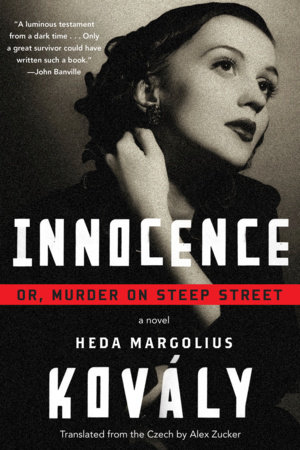
Innocence or murder on steep street by Heda Margolius Kovály

Innocence or murder on steep street by HedaMargolius  Kovály

Czech fiction

Original title –Nevina

Translator – Alex Zucker

Source – review copy

Tonight, tonight, I say goodbye
To everyone who loves me
Stick it to my enemies tonight
Then I disappear

Bathe my path in shining light
Set the dials to thrill me
Every secret has its price
This one’s set to kill

Too loose, too tight
Too dark, too bright
A lie, the truth
Which one should I use?
If the lie succeeds
Then you’ll know what I mean
When I tell you I have secrets to attend

Crime scene no1 by the afghan whigs is perfect match dark and brooding music like this book


Well today sees me in Eastern europe for Woman in translation month and a writer best known for her Memoir under a cruel star a memoir of her time in Auschwitz during the war . Well she wrote this novel in the years after the war when The Czech republic fell under soviet control , at the time she wrote the book it wasn’t allowed to be published and luckily a copy of the book managed to be saved to finally see the light of day in the 1980’s in Germany .Heda worked for many years translating book from English into Czech on of the writers she translated a lot of was the crime writer Raymond Chandler which is a obvious influence on this book .

“Believe me , I know .You can’t keep a secret at the Horizon .Anyway , if she did find somebody new  everyone’d badmouth her for runnin’ around on her man in the clink ,Meanwhile if the shoe was on the other foot and she was the one locked up her husband would find another girl in a week and people’d say

Helena and Karel he worked for the government and she had a better job before she went to the Horizon cinema .

The book revolves around a murder a young boy is found dead in a cinema and the staff of this cinema the Horizon  , the first section of the book is told from the perspective of on of the usherettes Helena .this first section tells what happened and then see some of the characters that crop up in the book like  people working in the cinema , the husband of Helena , Karel whom is in trouble with the authorities . the last two-thirds of the book are told by a nameless observer that watches why the boy was killed , who works for the government in the cinema , what really is happening ? which usher did it or was it them ? As we see the inspector trying to get to the bottom of it all .

The fat man hunched over in his chair and thought a moment

“Steep street is practically made for a knife ” he said .His voice was slow with sleepiness and husky , perhaps with the memory of the darkness on steep street .He laid a palm on his eyes and rubbed them as if trying to erase the sight from his mind .

I loved piece like this as they could have jumped of a hard-boiled american novel ,she caught that style of writing so well and Alex Zucker has retained in his translation .


This is an homage to two things firstly to Czech lit there is tones of Kafka here it is hard to avoid the feeling of Helena falling into one of those  Kafka like rabbit holes here as things started to fall into place.As every one isn’t what they first seems  and it is very easy to get caught up in the government web that is being woven  . The other is homage to Chandler and that style of crime novel , lots nods to american crime novels .The female character are like Chandlers but to me are maybe more rounded in the writing . There is feeling red herring and such here . The ushers whom fall suspect of the death of the young boy each have a connection and could be the killer . This is a book for lovers of both hard-boiled crime or Kafkaesque fiction . We are lucky it managed to avoid being destroyed by the censors .

Have you a favourite book in translation influenced by american fiction , but still keeping it identity ?